hydrostatics is the branch of fluid mechanics that studies "fluids at rest and the pressure in a fluid or exerted by a fluid on an immersed body".[1]
It encompasses the study of the conditions under which fluids are at rest in stable equilibrium as opposed to fluid dynamics, the study of fluids in motion. Hydrostatics are categorized as a part of the fluid statics, which is the study of all fluids, incompressible or not, at rest.
Hydrostatics is fundamental to hydraulics, the engineering of equipment for storing, transporting and using fluids. It is also relevant to geophysics and astrophysics (for example, in understanding plate tectonics and the anomalies of the Earth's gravitational field), to meteorology, to medicine (in the context of blood pressure), and many other fields.
Hydrostatics offers physical explanations for many phenomena of everyday life, such as why atmospheric pressure changes with altitude, why wood and oil float on water, and why the surface of still water is always level.
HISTORY -
Some principles of hydrostatics have been known in an empirical and intuitive sense since antiquity, by the builders of boats, cisterns, aqueducts and fountains. Archimedes is credited with the discovery of Archimedes' Principle, which relates the buoyancy force on an object that is submerged in a fluid to the weight of fluid displaced by the object. The Roman engineer Vitruvius warned readers about lead pipes bursting under hydrostatic pressure.[2]
The concept of pressure and the way it is transmitted by fluids was formulated by the French mathematician and philosopher Blaise Pascal in 1647.
HYDRO-STATICS IN ANCIENT GREECE AND ROME
The "fair cup" or Pythagorean cup, which dates from about the 6th century BC, is a hydraulic technology whose invention is credited to the Greek mathematician and geometer Pythagoras. It was used as a learning tool.
The cup consists of a line carved into the interior of the cup, and a small vertical pipe in the center of the cup that leads to the bottom. The height of this pipe is the same as the line carved into the interior of the cup. The cup may be filled to the line without any fluid passing into the pipe in the center of the cup. However, when the amount of fluid exceeds this fill line, fluid will overflow into the pipe in the center of the cup. Due to the drag that molecules exert on one another, the cup will be emptied.

Pythagorean Cup
Heron's fountain -

Pascal's contribution in hydro-statics -

Hydro-static pressure -
In a fluid at rest, all frictional and inertial stresses vanish and the state of stress of the system is called hydrostatic. When this condition of V = 0 is applied to the Navier–Stokes equations, the gradient of pressure becomes a function of body forces only. For a barotropic fluid in a conservative force field like a gravitational force field, the pressure exerted by a fluid at equilibrium becomes a function of force exerted by gravity.
The hydrostatic pressure can be determined from a control volume analysis of an infinitesimally small cube of fluid. Since pressure is defined as the force exerted on a test area (p = FA, with p: pressure, F: force normal to area A, A: area), and the only force acting on any such small cube of fluid is the weight of the fluid column above it, hydrostatic pressure can be calculated according to the following formula:

where:
- p is the hydrostatic pressure (Pa),
- ρ is the fluid density (kg/m3),
- g is gravitational acceleration (m/s2),
- A is the test area (m2),
- z is the height (parallel to the direction of gravity) of the test area (m),
- z0 is the height of the zero reference point of the pressure (m).
For water and other liquids, this integral can be simplified significantly for many practical applications, based on the following two assumptions: Since many liquids can be considered incompressible, a reasonable good estimation can be made from assuming a constant density throughout the liquid. (The same assumption cannot be made within a gaseous environment.) Also, since the height h of the fluid column between z and z0 is often reasonably small compared to the radius of the Earth, one can neglect the variation of g. Under these circumstances, the integral is simplified into the formula:

where h is the height z − z0 of the liquid column between the test volume and the zero reference point of the pressure. This formula is often called Stevin's law.[3][4] Note that this reference point should lie at or below the surface of the liquid. Otherwise, one has to split the integral into two (or more) terms with the constant ρliquid and ρ(z′)above. For example, the absolute pressure compared to vacuum is:

where H is the total height of the liquid column above the test area to the surface, and patm is the atmospheric pressure, i.e., the pressure calculated from the remaining integral over the air column from the liquid surface to infinity. This can easily be visualized using a pressure prism.
Hydrostatic pressure has been used in the preservation of foods in a process called pascalization
Atmospheric pressure -
Statistical mechanics shows that, for a gas of constant temperature, T, its pressure, p will vary with height, h, as:
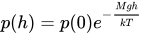
where:
- g is the acceleration due to gravity
- T is the absolute temperature
- k is Boltzmann constant
- M is the mass of a single molecule of gas
- p is the pressure
- h is the height
This is known as the barometric formula, and maybe derived from assuming the pressure is hydrostatic.
If there are multiple types of molecules in the gas, the partial pressure of each type will be given by this equation. Under most conditions, the distribution of each species of gas is independent of the other species.
Buoyancy -
Anybody of arbitrary shape which is immersed, partly or fully, in a fluid will experience the action of a net force in the opposite direction of the local pressure gradient. If this pressure gradient arises from gravity, the net force is in the vertical direction opposite that of the gravitational force. This vertical force is termed buoyancy or buoyant force and is equal in magnitude, but opposite in direction, to the weight of the displaced fluid. Mathematically,

where ρ is the density of the fluid, g is the acceleration due to gravity, and V is the volume of fluid directly above the curved surface.[6] In the case of a ship, for instance, its weight is balanced by pressure forces from the surrounding water, allowing it to float. If more cargo is loaded onto the ship, it would sink more into the water – displacing more water and thus receive a higher buoyant force to balance the increased weight.
Discovery of the principle of buoyancy is attributed to Archimedes.
Hydro-static force on submerged surfaces -
The horizontal and vertical components of the hydrostatic force acting on a submerged surface are given by the following:[6]

where:
- pc is the pressure at the centroid of the vertical projection of the submerged surface
- A is the area of the same vertical projection of the surface
- ρ is the density of the fluid
- g is the acceleration due to gravity
- V is the volume of fluid directly above the curved surface

